Python with Keyword
In Python programming, resource management is an important but easily overlooked aspect. The with keyword provides us with an elegant way to handle scenarios that require explicit resource release, such as file operations and database connections.
with is a keyword in Python used for the Context Management Protocol. It simplifies resource management code, especially for resources that need explicit release or cleanup (such as files, network connections, database connections, etc.).
Why Do We Need the with Statement?
Section titled “Why Do We Need the with Statement?”Problems with Traditional Resource Management
Section titled “Problems with Traditional Resource Management”Let’s first look at a typical file operation example:
Example
Section titled “Example”This approach has several problems:
- Easy to forget to close resources: Without the
try-finallyblock, you might forget to callclose() - Verbose code: Simple file operations require multiple lines of code
- Complex exception handling: You need to manually handle possible exceptions
Advantages of the with Statement
Section titled “Advantages of the with Statement”The with statement solves these problems through the Context Management Protocol:
- Automatic resource release: Ensures resources are properly closed after use
- Concise code: Reduces boilerplate code
- Exception safety: Even if an exception occurs in the code block, resources are properly released
- Strong readability: Clearly identifies the scope of resources
Basic Syntax of the with Statement
Section titled “Basic Syntax of the with Statement”Basic Usage
Section titled “Basic Usage”The basic form of the with statement is as follows:
Syntax Format
Section titled “Syntax Format”expressionreturns an object that supports the context management protocolas variableis optional, used to assign the expression result to a variable- After the code block finishes executing, the cleanup method is automatically called
File Operation Example
Section titled “File Operation Example”The most common application of the with statement is file operations:
Example
Section titled “Example”This code is equivalent to the previous try-finally implementation but is more concise and clear.
How the with Statement Works
Section titled “How the with Statement Works”Context Management Protocol
Section titled “Context Management Protocol”Behind the with statement is Python’s context management protocol, which requires objects to implement two methods:
__enter__(): Called when entering the context, the return value is assigned to the variable afteras__exit__(): Called when exiting the context, handles cleanup
Execution Flow
Section titled “Execution Flow”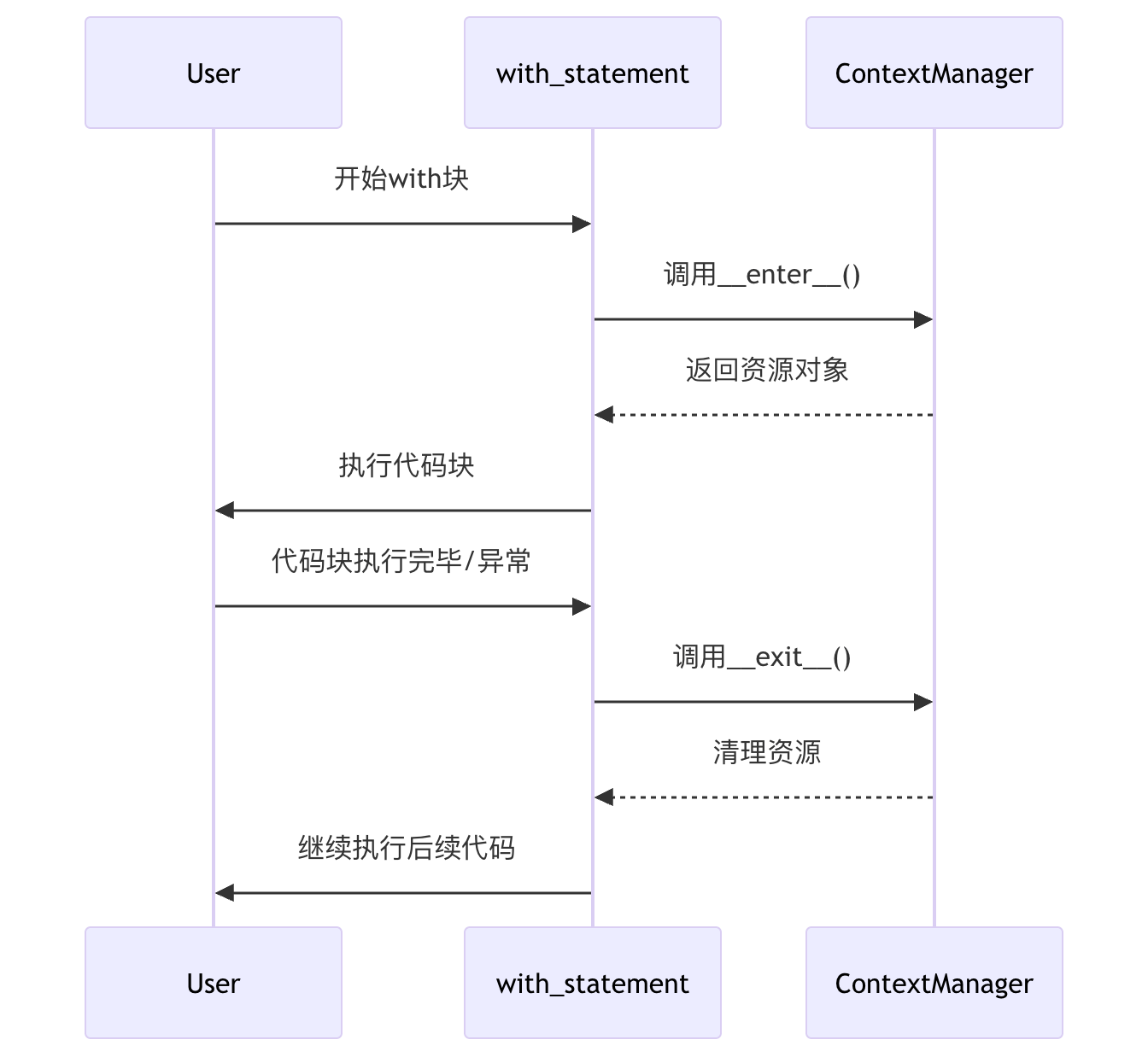
Exception Handling Mechanism
Section titled “Exception Handling Mechanism”The __exit__() method receives three parameters:
exc_type: Exception typeexc_val: Exception valueexc_tb: Exception traceback information
If __exit__() returns True, the exception is considered handled and will not propagate further; returning False or None means the exception will continue to propagate outward.
Practical Application Scenarios
Section titled “Practical Application Scenarios”1. File Operations
Section titled “1. File Operations”Example
Section titled “Example”2. Database Connections
Section titled “2. Database Connections”Example
Section titled “Example”3. Thread Locks
Section titled “3. Thread Locks”Example
Section titled “Example”4. Temporarily Modifying System State
Section titled “4. Temporarily Modifying System State”Example
Section titled “Example”Creating Custom Context Managers
Section titled “Creating Custom Context Managers”Class Implementation
Section titled “Class Implementation”We can create custom context managers by implementing the __enter__ and __exit__ methods:
Example
Section titled “Example”Using the contextlib Module
Section titled “Using the contextlib Module”Python’s contextlib module provides a simpler way to create context managers:
Example
Section titled “Example”Output:
Common Issues and Best Practices
Section titled “Common Issues and Best Practices”Common Mistakes
Section titled “Common Mistakes”1. Mistakenly believing that with can only be used for files:
Example
Section titled “Example”2. Ignoring the return value of __exit__:
Example
Section titled “Example”Best Practices
Section titled “Best Practices”- Prioritize using with for resource management: For resources such as files, network connections, and locks, always consider using the
withstatement - Keep contexts concise: Code in the
withblock should only contain operations related to the resource - Handle exceptions properly: In custom context managers, decide whether to suppress exceptions based on requirements
- Utilize multiple contexts: Python allows managing multiple resources in a single
withstatement
Summary of Key Points
Section titled “Summary of Key Points”| Key Point | Description |
|---|---|
| Automatic resource management | The with statement ensures resources are properly released |
| Context protocol | Requires implementing __enter__ and __exit__ methods |
| Exception safety | Even if an exception occurs in the code block, resources are released |
| Common applications | File operations, database connections, thread locks, etc. |
| Custom implementation | Custom context managers can be created via classes or contextlib |
The with statement is a powerful feature in Python. It not only simplifies code but also improves program robustness. Mastering the use and principles of the with statement will help you write more professional and reliable Python code.